
Industries
Parking Lot and Garage Security in Palo Alto
Security for Palo Alto parking garages and lots: randomized patrol rounds through every level, gate, ramp and stairwell checks, after-hours closing and posted officers for the busiest hours, reported to the property manager.
Request a quoteCall (650) 457-8658
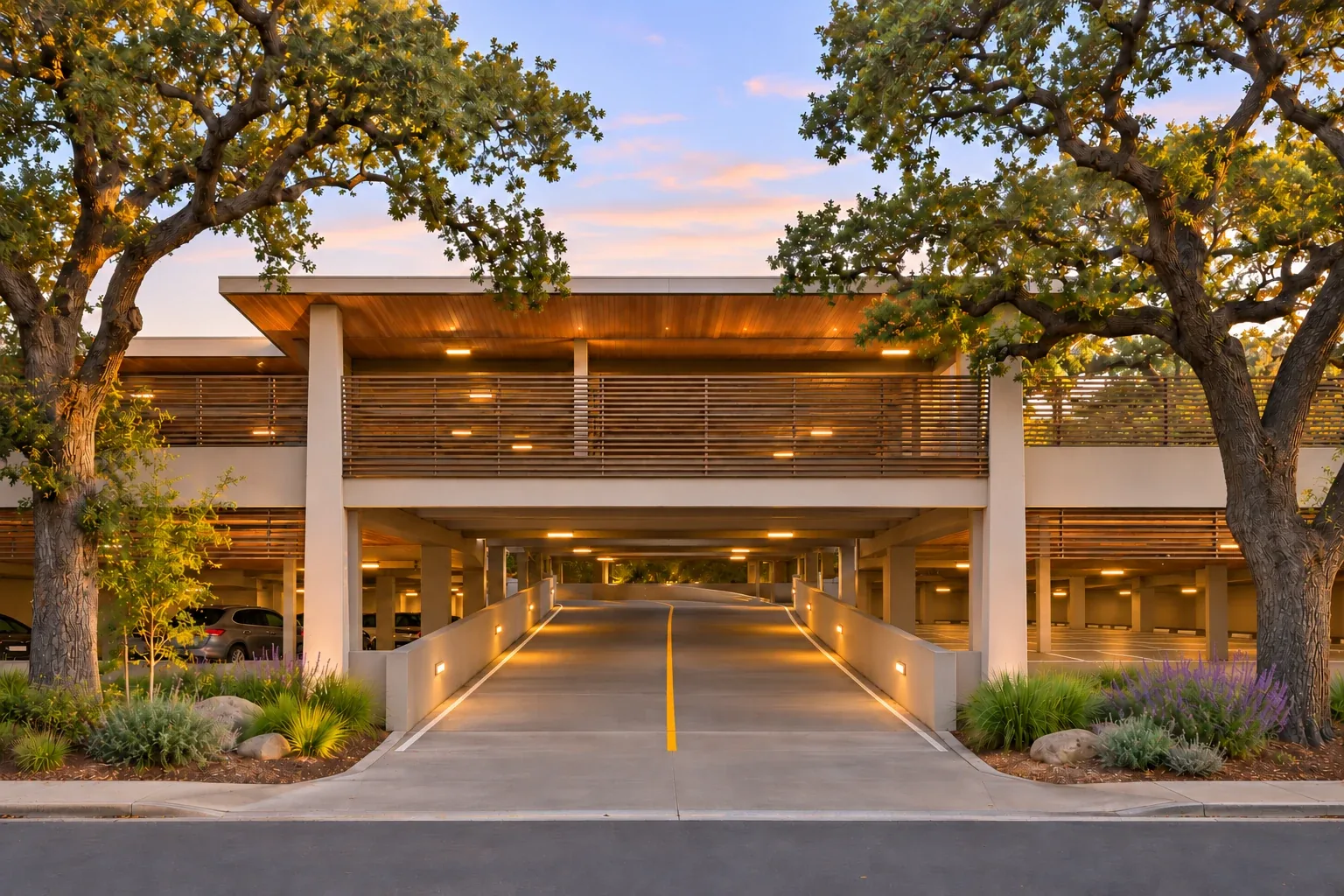
Where a parking facility feels least secure
A garage or lot is often the first and last part of a property that tenants, employees and visitors experience each day, and it is usually the part with the least supervision. Lower levels empty out after the evening commute, stairwells and elevator lobbies sit out of view and the far corners of a surface lot see few people after dark. Those are the places where car break-ins, catalytic converter theft, loitering and vandalism tend to happen.
In practice, the goal is not to watch every space. It is to make the facility feel attended: officers seen at irregular times, lights and doors that work, problems written down and fixed. Drivers notice the difference, and so do people looking for an easy target.
Patrol rounds through levels and lots
For most garages and lots, mobile patrol is the backbone of coverage. Officers in marked vehicles arrive at varied times each night, so the pattern cannot be learned. On each visit they drive or walk every level, check stairwells and elevator lobbies, look for broken glass and vehicles that have not moved and test the doors that should be locked.
Each visit is recorded in a timed log with what the officer found. Surface lots get the same attention along their perimeter, around dumpster enclosures and at the far corners that are hard to see from the street.
Gates, ramps, pay stations and after-hours closing
Gate arms, rolling doors, ramps and pay stations are checked on every round. An officer confirms that gates are closed at the posted hour, that the ramp to a closed level is chained or coned off and that pay machines and ticket kiosks show no sign of tampering. Where a garage closes overnight, a closing round clears the levels before the doors come down, so no one is locked in and no one stays behind unnoticed.
Failed lights, broken cameras, damaged fencing and graffiti are photographed and reported the same night, which lets the manager book repairs before a small problem becomes an invitation.
Posted officers for the busiest hours
Some facilities need a person on site rather than periodic visits. A garage that serves an office building can post an officer for the evening hours when employees walk to their cars, offering escorts on request and keeping an eye on the elevator lobby. Garages beside venues or busy dining streets often add an officer for event nights. An unarmed officer suits most posts, and an armed officer is available where a risk review calls for one.
Our guide to patrol versus a posted officer sets out the trade-offs, and many sites combine the two: a posted officer through the evening rush and randomized patrol after midnight.
Unauthorized vehicles, loitering and overnight sheltering
Officers handle people and vehicles courteously and by the property’s rules. A car parked overnight where it should not be is noted with its plate, location and time, and the report goes to the manager, who decides on warnings or towing. People loitering or sleeping in a stairwell are approached politely and asked to move on, and anything that calls for police is reported to them right away.
Parking across Palo Alto
Palo Alto’s parking is spread across very different settings: garages beneath and beside the office buildings of downtown and the University Avenue district, structures and lots around California Avenue, large surface lots across the research and office campuses near Page Mill Road, and garages serving retail and medical buildings along El Camino Real. Lots along East Bayshore Road and U.S. 101 see a different pattern again, quiet at night and close to the freeway.
Each setting gets its own plan. Office garages tie into the coverage on our office and campus security page, while residential garages in apartment and mixed-use buildings follow the approach on our apartment and HOA page, with quieter rounds and attention to resident access.
Reports, cameras and supervision
Managers receive a shift report by email after each night of coverage, and incident reports include photos. Garages with good camera coverage can pair patrol with remote video monitoring, so activity on a level gets a check on the ground. Every officer is background-checked and holds a BSIS guard card, supervisors carry out quality inspections and each client receives a certificate of insurance.
Parking security costs in Palo Alto
Patrol is priced by the minute on site, at $2 to $3 a minute with a five-minute minimum per visit, so the total depends on how many visits a night and how long each round takes for the size of the facility. A posted unarmed officer typically runs $36 to $50 an hour, and an armed officer $60 to $75. Agreements are month to month, so coverage can be adjusted after the first reports or for a busy season. A free walkthrough of the levels and lots comes first, followed by a written quote.
A few useful answers
Common questions
How many patrol visits does a Palo Alto parking garage need each night?
Garage size and the hour it empties out set the count. A common starting point is two to four randomized visits a night, adjusted once a few weeks of reports show where the activity is.
Will officers check every level of a multi-level garage?
Yes. Each round covers every level, the stairwells, elevator lobbies and ramps, and the timed log shows when each part was checked.
Can an officer walk employees to their cars after work?
Yes. A posted officer can offer escorts on request during the evening hours when staff leave, and that time is written into the post orders.
What happens when an officer finds a break-in or a damaged car?
The officer photographs the vehicle and the area, notes the plate and time, contacts police where needed and sends an incident report to the manager so the owner can be told.
Can we combine patrol with our existing cameras?
Yes. Patrol and remote video monitoring work well together in garages: the cameras watch the quiet hours and an officer checks on the ground when something needs attention.
Services